Mechanism of Implementation
Implementation Mechanism
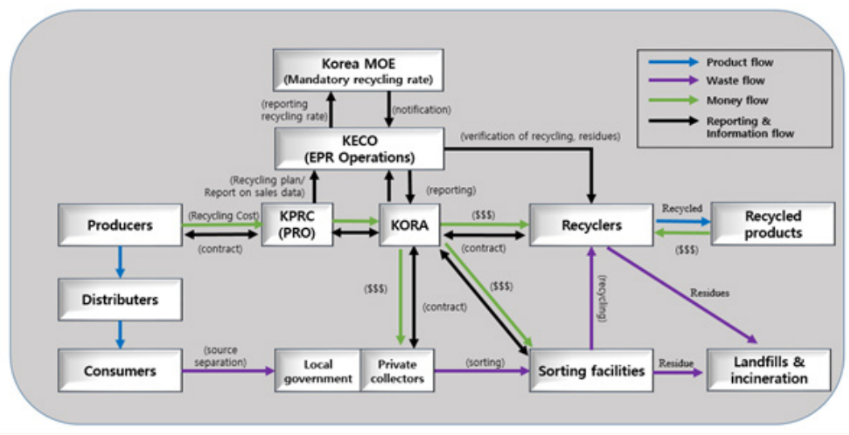
The implementation of the EPR system in Korea is overseen by the Korea Environment Corporation (KECO), a state-owned enterprise authorised by the Ministry of Environment (MoE) to execute its policies. For EPR for packaging, KECO is tasked with recording production or import data from producers, establishing guidelines for the recycling processes, and monitoring and verifying producers' recycling performance.
In fulfilling their recovery and recycling obligations, producers and importers have the option to establish individual EPR schemes or collectively join a producer responsibility organisation (PRO) – a choice favoured by most producers. The designated PRO for packaging is the Korea Packaging Recycling Cooperative (KPRC), responsible for collecting recycling fees and gathering information and statistics on the production, import, and recycling of packaging materials from its members. However, the KPRC is not directly involved in managing collection and packaging; this responsibility falls to the Korea Resource Circulation Service Agency (KORA).
KORA, a state organisation under the MoE, facilitates waste collection and recycling by coordinating with local governments, waste management organisations (WMOs), and recyclers. Household waste is collected by local governments, while WMOs, selected through public tenders, handle industrial waste collection. KORA uses the recycling fees collected by the PRO to finance waste collection and distribute funds to local governments and WMOs. KORA also issues service provision agreements with recyclers, assigning them tasks related to recycling and marketing recyclates.
KECO conducts quarterly on-site verification of producer performance in collecting and recycling plastic packaging based on reported information. KECO then submits a report on producer compliance with EPR obligations to the MoE. The Korean EPR system for packaging is depicted below.
 for Plastics and Packaging-66a22ce456fdd.jpg)











 Indonesia
 Malaysia
 Brunei Darussalam
 Cambodia
 Lao PDR
 Myanmar
 Philippines
 Singapore
 Thailand
 Viet Nam
 China
China
 Republic of Korea
 Japan
Japan